
Ohari
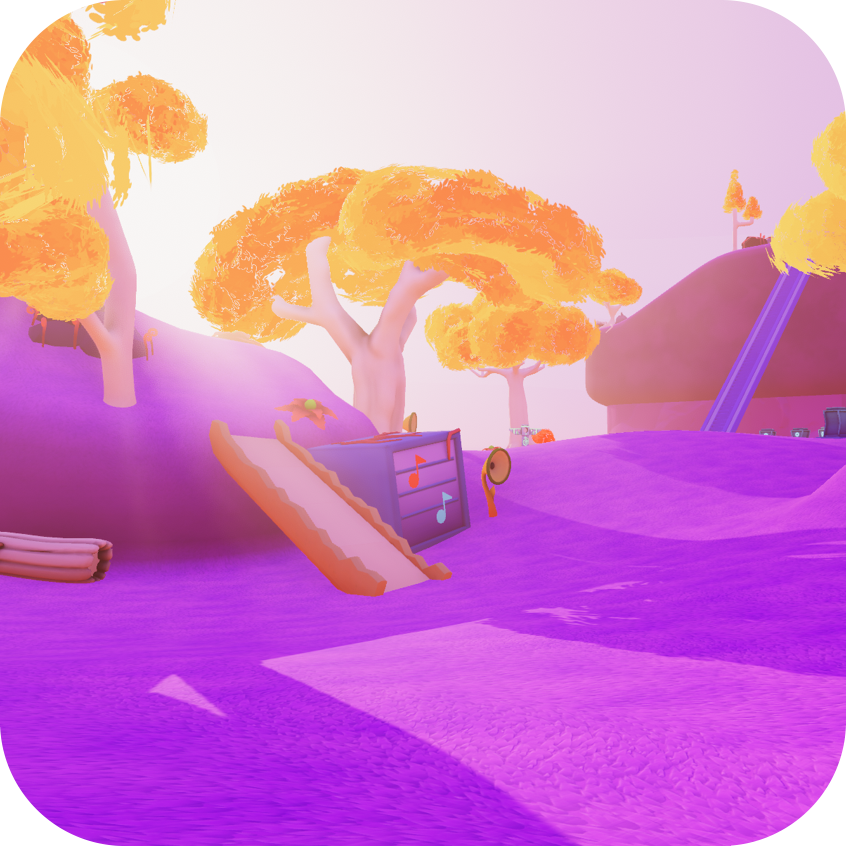
Walk around, equipped with your photo camera and take pictures of this strange world's fauna and flora.
Design
Ohari is my last school project before graduation in third year. And as such we formed a team of 5 with big ambitions, and now with some experience hope for a demo release level product at the last deadline.
To proceed in step, our first goal was to make a fun toy to then later expend it to a full game experience of at least 30-45 min. Our toy is simple, you can walk around an environment populated by creatures, and take pictures of them if they are visible enough.
The first iterations already displayed the controller as it is, that means a simple third person controller that can walk but not jump. And the ability to shift to first person to take picture but not move. The toy was set in a very restricted scene, but allowed us to explore our potential artistic direction.
Making the toy
The toy was only the controller and a few entities. But I only worked on the controller and pictures taking, and with such a basic controller the picture taking was the most important and interesting part of my work.
To take a picture of an entity, it needs to be well framed and fully visible. I explored multiple methods of checking how well the entity is positioned in frame. My original plan was to use the bounds of the mesh. But this means checking corner which, when up close, were often outside of the frame despite the model being entirely visible.
Ultimately I chose a mix of raycast and custom bounding box.
To know how much of an entity is obscured, I built a tool that sample the mesh and bake in X sample points being vertices. Chosen to be spread on the whole mesh, and sure to count it all the vertices of every extremities in order to build a correct bound. When a picture is taken, instead of checking the bounds of the entity, this array of position is used instead. If every position is within the bound of the frame, the entity is considered valid in the picture.
This also added the ability of building a rect bounds from these sampled points, giving a very tight rect around the mesh that I could use for UI feedback.
The rest of the job for the prototype was the sound design, simple sfx for the controller which mostly stayed the same all through.
Evolving into a game
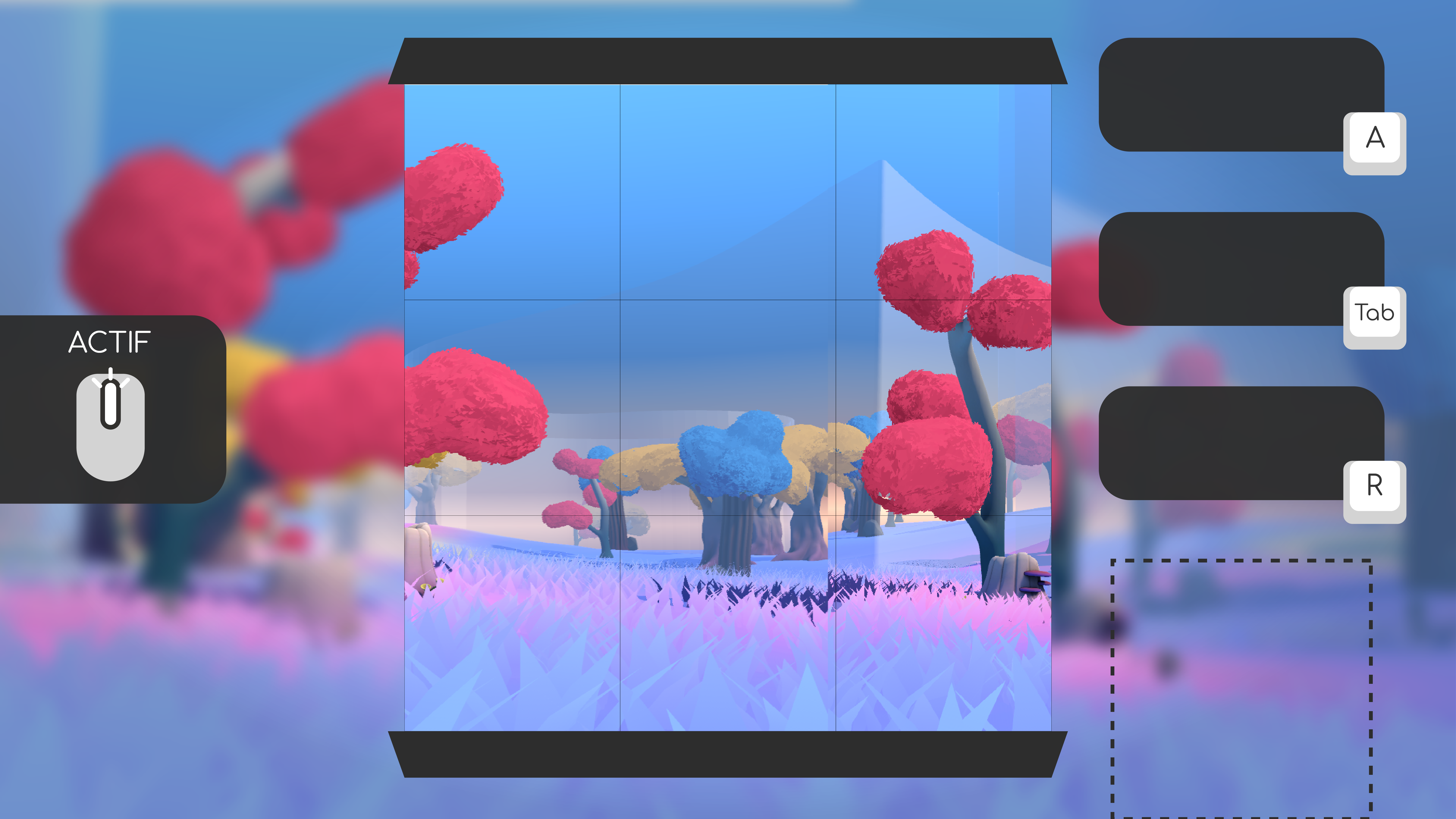
This is unfortunately where the design took a wrong turn. We went on a puzzle game, based on player abilities from camera upgrade unlocked by taking pictures.
Each creature would have X states (hiding, peeking, ect...) and by taking pictures of the creature in each of it's state, the player could unlock a new upgrade. To help them, they would be given an encyclopedia in which when a valid picture is added, a hint toward the next state could be given.
The different upgrades could be a flash, a klaxon, a rock launcher ect... and with them the player could interact with the world in new way, and solve puzzle along the way.
I was charged of doing the upgrade system, and the upgrade themselves. Most of it was straight forward, each one was responsible for one task and one only.
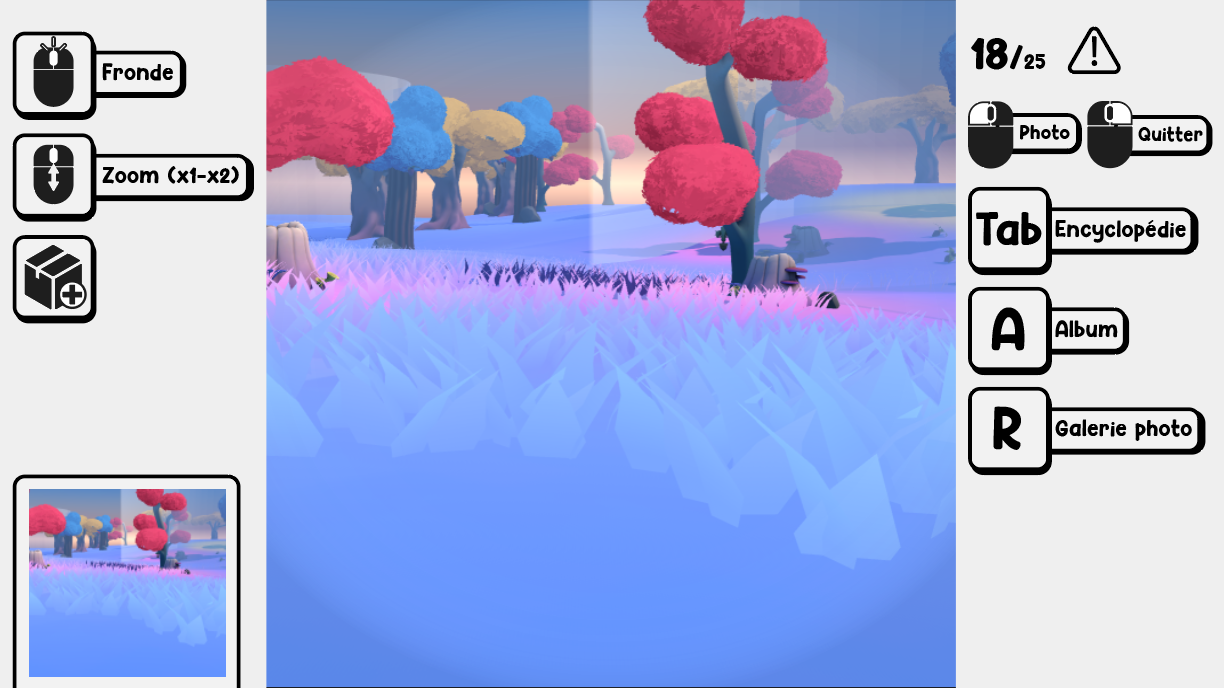
The end of this project was focused on it's UI, which you can check out it the trailer and by checking out the game yourself ! most of my project are available on my itch.io page.
And finally of course sound design, beside of the sounds for the creatures and new upgrades, it's at that time I composed a quick tune for the game. Once again we wanted somewhat dynamic music, and since we had a focus on exploring I decided to map the different area with different layers of music. The music is composed of a loop with several variation and layers that get activated or deactivated depending on where on the map.
Once again I made a simple tool to have bounding box with a transition area, it would be like having two box, one inside the other. Depending on the player position, parameter would be interpolated using the player position in relation to the outside bound and inside bound.
Rewriting the plot
The design isn't bad as is, however, the challenges the player faces should have been focused on player perspective much more than on cheap upgrades. In my opinion, the idea of upgrades could have been completely discarded, and instead focus on a perspective challenge like game such as the witness or super liminal. Easy to say once everything settles, but I'm not disappointed with how this game turned out to be.
The tutorial is lacking, it was stitched together at the end so of course it is, but it still is doing alright as a product, and is definitely worth a revisit some day.